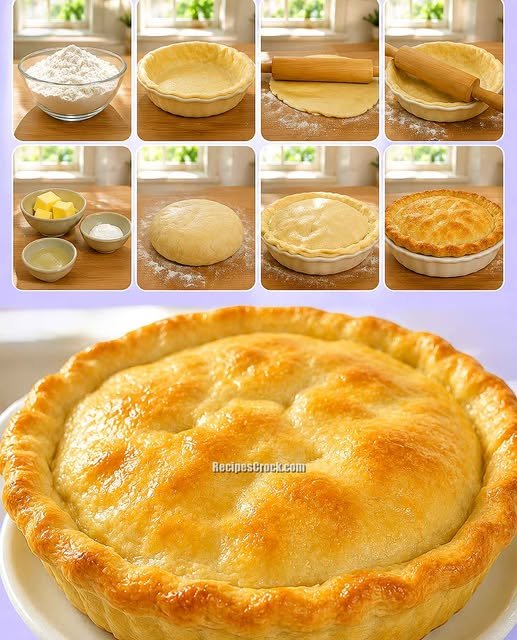
| Category | Details |
|---|---|
| Prep Time | 20 minutes |
| Chill Time | 1 hour (minimum) |
| Total Time | 1 hour 20 minutes |
| Intensity | Medium – Requires patience and gentle handling, but no special equipment. |
| Yield | Two 9-inch pie crusts (one double-crust pie or two single shells) |
Intensity scale: Easy → Medium → Challenging. This crust is medium because temperature control and minimal handling are critical, but the steps are straightforward.
🥧 Ingredients
For the dough:
-
2 ½ cups (315g) all-purpose flour – spooned and leveled
-
1 teaspoon fine sea salt
-
1 tablespoon granulated sugar (omit for savory pies)
-
1 cup (226g) unsalted European-style butter (cold, cut into ½-inch cubes)
-
6–8 tablespoons ice water
-
1 tablespoon apple cider vinegar
For assembly (if blind baking):
-
Pie weights, dried beans, or rice
-
1 egg beaten with 1 tablespoon water (egg wash)
📝 Step-by-Step Instructions
1. Chill Everything First
Place your butter cubes in the freezer for 10 minutes. Measure your flour into a metal bowl and chill that too. Fill a glass with water and ice cubes – you’ll measure from this. Grandmother’s rule: If your hands feel warm, run them under cold water before touching the dough.
2. Combine Dry Ingredients
In a large, chilled bowl, whisk together the flour, salt, and sugar. Work quickly to keep the flour cool.
3. Cut in the Butter
Scatter the frozen butter cubes over the flour. Using a pastry blender (or two knives), cut the butter into the flour until the mixture resembles coarse meal with pea-sized butter pieces. Some larger, lima-bean-sized bits are perfect – those create steam pockets for flakiness.
Do not overwork. If the butter starts to soften, stop and chill the bowl for 10 minutes.
4. Add Wet Ingredients
In a small bowl, combine 6 tablespoons of ice water with the apple cider vinegar. Drizzle 5 tablespoons over the flour-butter mixture. Using a fork or your fingertips (quickly!), toss the mixture until it begins to clump together. Add the remaining 1–2 tablespoons of water only if the dough feels too dry – it should just hold together when squeezed.
Grandmother’s test: Squeeze a handful of dough. If it stays in a clump without crumbling, you’re done. If it falls apart, add another teaspoon of water.
5. Bring the Dough Together
Turn the shaggy dough onto a lightly floured surface. Gently press and fold it with your bench scraper or hands until it just comes together – about 6 to 8 presses. Divide the dough into two equal discs. Wrap each tightly in plastic wrap and refrigerate for at least 1 hour (or up to 3 days). This rest is non-negotiable: it relaxes gluten and re-chills the butter.
6. Roll the Dough (After Chilling)
Let one disc sit at room temperature for 5–10 minutes to soften slightly. On a well-floured surface, roll from the center outward, rotating the dough a quarter turn every few rolls. Keep the circle about ⅛ inch thick and 12 inches wide (for a 9-inch pan).
Troubleshooting: If the dough cracks at the edges, too cold – wait another minute. If it sticks, add more flour underneath. If it becomes greasy, chill it on a baking sheet for 15 minutes.
7. Transfer to Pie Plate
Loosely fold the dough in half, then in half again (into quarters). Place the point in the center of your pie plate and unfold. Gently ease the dough into the bottom and up the sides – do not stretch, or it will shrink while baking. Trim the overhang to ½ inch.
8. Crimp or Flute
For a single crust: fold the overhang under itself to create a thicker rim, then crimp with your fingers or a fork. For a double crust (like apple pie): fill the bottom crust, top with second rolled disc, trim, seal, and cut vents.
9. Blind Bake (If Required)
For custard or cream pies, blind-bake first:
-
Prick bottom crust with a fork.
-
Line with parchment, fill with pie weights.
-
Bake at 375°F (190°C) for 15 minutes.
-
Remove weights and parchment, brush with egg wash, bake 10–12 more minutes until golden.
10. Fill and Bake as Your Recipe Directs
🔥 Grandmother’s Tips for Perfection
-
Keep your tools cold – Freeze your pastry blender and measuring cups before starting.
-
Never add warm water – Always ice water. Warm water melts the butter.
-
Use vodka for extra flakiness – Replace 2 tablespoons of ice water with cold vodka. It evaporates faster, reducing gluten formation.
-
Rescue sticky dough – Sprinkle flour over the surface, never knead it in.
-
Store leftovers – Wrapped raw dough freezes beautifully for up to 3 months.
❄️ Make-Ahead & Storage
-
Refrigerate: Wrapped dough discs keep for 3 days.
-
Freeze: Double-wrap in plastic and foil. Thaw overnight in the refrigerator before rolling.
-
Baked crust: Cool completely, then store at room temperature loosely covered for up to 2 days.
📊 Nutrition Information
*Per serving (1/8 of a single 9-inch crust, without filling)*
Based on using all-purpose flour, unsalted butter, and no sugar (savory variation)
| Nutrient | Amount |
|---|---|
| Calories | 198 kcal |
| Total Fat | 13 g |
| Saturated Fat | 8 g |
| Trans Fat | 0 g |
| Cholesterol | 34 mg |
| Sodium | 146 mg |
| Total Carbohydrate | 18 g |
| Dietary Fiber | 0.6 g |
| Sugars | 0.2 g |
| Protein | 2.5 g |
| Calcium | 7 mg |
| Iron | 1 mg |
| Potassium | 26 mg |