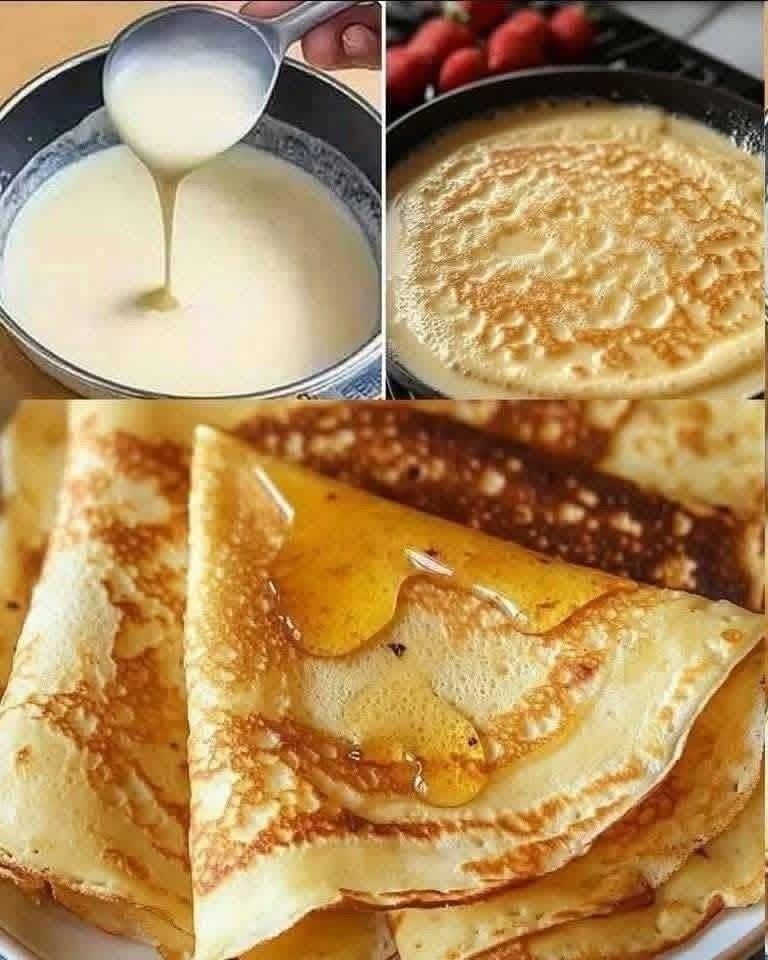
| Category | Details |
|---|---|
| Prep Time | 10 minutes (plus 30 minutes resting – optional but recommended) |
| Cook Time | 15–20 minutes (for about 12–14 crêpes) |
| Total Time | 25–30 minutes (or 55 minutes with resting) |
| Intensity | ★★☆☆☆ (Easy – requires a bit of patience for flipping) |
| Yield | 12–14 crêpes (6–7 inches / 16–18 cm diameter) |
| Serving Size | 2 crêpes per person as a main, 1 crêpe as a snack or dessert |
Intensity breakdown:
Batter mixing: Very easy (just whisking)
Pan technique: Moderate (needs even spreading and quick flipping)
Cleanup: Easy (one bowl, one whisk, one pan)
Ingredients
For the batter, simplicity is key. You likely have everything in your pantry right now.
Dry Ingredients
-
1 cup (125 g) all-purpose flour (plain flour)
-
2 tablespoons (25 g) granulated sugar (omit for savory crêpes)
-
¼ teaspoon fine sea salt
Wet Ingredients
-
2 large eggs (room temperature)
-
1¼ cups (300 ml) whole milk (room temperature – crucial for lump-free batter)
-
2 tablespoons (30 g) unsalted butter, melted + extra for greasing the pan
-
½ teaspoon vanilla extract (optional – for sweet crêpes)
For Cooking
-
Neutral oil or additional melted butter – for lightly greasing the pan between crêpes
Optional Toppings (Sweet)
-
Fresh berries, sliced bananas, lemon juice, powdered sugar, chocolate hazelnut spread, whipped cream, maple syrup, or jam.
Optional Fillings (Savory)
-
Ham, grated Gruyère or Swiss cheese, sautéed mushrooms, spinach, scrambled eggs, smoked salmon, or roasted vegetables.
Equipment Needed
-
Non-stick skillet or crêpe pan (8–10 inches / 20–25 cm diameter) – a shallow, sloped-sided pan is ideal.
-
Mixing bowl (medium)
-
Whisk or fork
-
Ladle (about ¼ cup / 60 ml capacity)
-
Silicone spatula or offset spatula (for flipping assistance, though you can use fingers too)
-
Pastry brush (optional – for greasing)
-
Large plate (for stacking finished crêpes)
Step-by-Step Instructions
1. Make the Batter (2 minutes, low intensity)
In a medium mixing bowl, combine the flour, sugar (if using), and salt. Whisk briefly to aerate and break up any lumps. Create a small well in the center.
Crack the eggs into the well. Pour in about ¼ cup of the milk. Begin whisking from the center, gradually pulling in the flour from the edges. The mixture will be very thick and pasty at first – that’s normal. Continue whisking, adding the remaining milk in a slow, steady stream, until you have a smooth, thin batter about the consistency of heavy cream.
Finally, whisk in the melted butter and vanilla (if using). The butter should be warm but not scorching hot, so it incorporates without cooking the eggs.
2. Rest the Batter (Optional but Recommended – 30 minutes, zero intensity)
For the most tender crêpes with no tough spots, cover the bowl with plastic wrap or a clean kitchen towel and let the batter rest at room temperature for 30 minutes. This allows the gluten to relax and the starch granules to fully hydrate. If you’re in a rush, you can skip this – but do so knowing your crêpes might be slightly less delicate.
Pro tip: You can also refrigerate the batter for up to 48 hours. Just whisk it gently before using, as some separation occurs.
3. Preheat the Pan (1–2 minutes, low intensity)
Place your non-stick skillet over medium heat. Let it warm up for at least a minute. A properly heated pan is the single biggest factor between a crêpe that spreads beautifully and one that sets into a sad, thick lump.
Test the temperature by flicking a drop of water onto the pan – it should sizzle and evaporate immediately, not dance around frantically. Or touch the edge of a butter pat to the pan; it should melt with a gentle sizzle but not brown instantly.
4. Grease the Pan (30 seconds, very low)
Lightly brush the pan with a thin layer of melted butter or neutral oil. Use a paper towel to wipe away any excess – you want only the faintest sheen. Too much grease will cause the batter to slide around unevenly and create greasy, lacy edges.
5. Ladle and Swirl – The Signature Move (15–20 seconds per crêpe, moderate intensity)
Hold the pan handle in your non-dominant hand (or use an oven mitt if the handle gets hot). With your other hand, pour about ¼ cup (60 ml) of batter into the center of the pan.
Immediately tilt and rotate the pan in a circular motion so the batter flows outward and covers the entire bottom in a thin, even layer. Work quickly – the batter begins to set as soon as it hits heat. If you get small holes, a quick swirl usually patches them. If the batter is too thick to spread, add 1–2 tablespoons more milk to the bowl.
Troubleshooting: If your first crêpe is a disaster (too thick, torn, or uneven), don’t be discouraged. The first one is always a test. Adjust heat and batter consistency as needed.
6. Cook the First Side (45–60 seconds, low intensity)
Let the crêpe cook undisturbed until the edges start to pull away slightly from the pan and the top surface looks mostly dry (tiny moist spots are fine). The bottom should be lightly golden with a few brown speckles. If the edges are burning before the top sets, your heat is too high. If the crêpe is pale and floppy after 90 seconds, increase the heat a notch.
7. Flip with Confidence (5 seconds, moderate intensity)
Slide a thin spatula under the crêpe to loosen it. Then, using your fingertips (or the spatula), grab the edge, lift, and flip it over in one swift motion. Alternatively, you can toss the crêpe by jerking the pan forward and upward – a showy move that takes practice. For home cooks, the spatula-and-fingers method is perfectly fine.
8. Cook the Second Side (20–30 seconds, low intensity)
The second side cooks much faster. Once you see a few small golden bubbles and the crêpe lifts easily from the pan, it’s done. Slide it onto a plate.
9. Stack and Keep Warm
Repeat steps 4–8 with the remaining batter, greasing the pan very lightly before each crêpe (often only needed every second or third crêpe). Stack the finished crêpes directly on top of each other on a plate – they won’t stick. Cover loosely with a clean kitchen towel or place the plate in a 200°F (95°C) oven to keep warm.
Tips for Perfect Crêpes Every Time
-
Room temperature ingredients – Cold milk or eggs can seize the melted butter and create lumps. Let them sit out for 20 minutes before starting.
-
Thin batter – The batter should flow like heavy cream. If it seems too thick (doesn’t spread easily), whisk in extra milk 1 tablespoon at a time.
-
Heat management – Medium heat is ideal for most stovetops. If crêpes are browning too fast, lower the heat. If they’re pale and stiff, increase slightly.
-
No overmixing – Stir just until smooth; a few tiny lumps are fine. Overworking the batter develops gluten, making crêpes tough.
-
Practice flipping – Use a silicone spatula if you’re nervous. You can also fold the crêpe in half, then half again right in the pan to serve as a triangle – no perfect flip required.
Delicious Variations
Gluten-Free Crêpes
Substitute the all-purpose flour with a gluten-free 1:1 baking blend (containing xanthan gum). Add an extra tablespoon of milk, as GF flours absorb more liquid. Texture will be slightly more delicate, but still wonderful.
Dairy-Free / Vegan Crêpes
Use unsweetened almond or oat milk, replace butter with coconut oil (melted), and substitute eggs with 2 tablespoons of ground flaxseed mixed with 6 tablespoons of water (let gel for 10 minutes). The batter will be thinner; cook slightly longer.
Buckwheat Galettes (Savory Brittany-Style)
Replace half or all of the flour with buckwheat flour. Omit sugar, add a pinch more salt. These are traditionally filled with ham, egg, and cheese – the nutty, earthy flavor pairs perfectly with savory ingredients.
How to Store and Reheat Crêpes
Refrigerator: Stack cooled crêpes with a small piece of parchment paper between each, wrap tightly in plastic wrap, and refrigerate for up to 3 days.
Freezer: Same parchment-layer method, then place in a freezer bag. Freeze for up to 2 months. To thaw: leave in fridge overnight or microwave for 15 seconds.
Reheat: Quickly reheat in a dry non-stick pan over medium heat for 10–15 seconds per side, or stack them (wrapped in a damp paper towel) in the microwave for 20 seconds.
Nutrition Information (per 1 crêpe, unsweetened, no filling)
The following values are estimates based on the basic recipe (with whole milk, butter, and eggs, without sugar or vanilla). Sweet crêpes with sugar add about 8–10 calories and 2g carbohydrates per crêpe.
| Nutrient | Amount |
|---|---|
| Calories | 95 kcal |
| Total Fat | 4.5 g |
| – Saturated Fat | 2.5 g |
| Cholesterol | 40 mg |
| Sodium | 65 mg |
| Total Carbohydrates | 10 g |
| – Dietary Fiber | 0.3 g |
| – Sugars | 1.5 g |
| Protein | 3.5 g |
| Calcium | 40 mg |
| Iron | 0.6 mg |